The Problem Nobody Was Solving
The luxury ground transportation industry in the Tri-State Area — New York, New Jersey, Connecticut — is massive. Corporate executives, high-net-worth individuals, and enterprise clients move constantly. Airport transfers, executive travel, long-distance rides, hourly engagements — the demand is real and consistent.
But the technology? Broken.
Uber and Lyft are built for volume, not excellence. They were never designed for a client who expects a pre-vetted, professionally trained chauffeur in an executive-class vehicle, on time, every single time. The legacy players — traditional limo and black car services — were operating on phone calls, WhatsApp messages, and manual dispatch. No real-time tracking. No seamless booking. No digital infrastructure whatsoever.
TriStateService LLC was one of those companies. Premium service, professional chauffeurs, a fleet of executive and luxury vehicles — but zero technology to scale or modernize their operations.
That's where I came in.
---
What I Set Out to Build
The goal was clear: build a full ride-hailing ecosystem specifically engineered for luxury and corporate transportation. Not a prototype. Not an MVP held together with duct tape. A real, production-grade platform that could compete with any enterprise mobility solution.
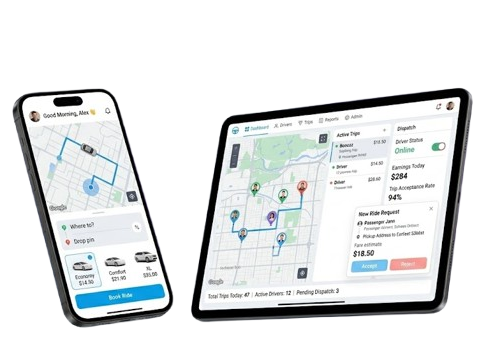
That meant three separate applications sharing one unified backend:
- A passenger app for iOS and Android — clean, premium, intuitive
- A driver/chauffeur app — purpose-built for professional chauffeurs
- A super admin panel — full operational control center
One engineer. Three apps. One backend. Built and shipped.
---
The Architecture Decision
Before writing a single line of code, I had to make smart architectural choices. The wrong stack here would mean months of pain later.
Mobile: Expo (React Native)Cross-platform was non-negotiable. Building separate native iOS and Android codebases solo would have been commercially irresponsible. Expo gave me the right balance — near-native performance, a single codebase, and fast iteration cycles. Both the passenger app and the driver app are built on Expo, sharing a common design system and utility layer while maintaining completely separate user flows, permissions, and logic.
Admin Panel: Next.js + Tailwind CSSThe super admin panel needed to be fast, scalable, and capable of handling real-time data updates — ride monitoring, driver locations, fleet status, revenue dashboards. Next.js was the right call. Server-side rendering for performance, API routes for tight backend integration, and Tailwind for a professional UI without the overhead of a heavy component library.
Backend: Node.js + Express.jsExpress gave me the speed and flexibility to build a well-structured REST API without overengineering. The backend handles everything — authentication, ride lifecycle management, real-time communication via Socket.io, payment processing, driver-passenger matching, and admin operations. One backend, serving all three clients cleanly.
Database: PostgreSQL + RedisRelational data for users, rides, vehicles, and transactions lives in PostgreSQL. Redis handles session management, caching, and real-time pub/sub for ride state updates. This combination keeps the system fast and consistent under load.
Payments: StripeStripe for payment processing was an obvious choice. Clean API, strong documentation, and built-in support for corporate accounts and invoicing — which matters for B2B clients.
Maps: Google Maps PlatformReal-time chauffeur tracking, route optimization, and ETA calculation all run on Google Maps APIs. For luxury clients, accuracy and reliability here is non-negotiable.
---
Building the Passenger App
The passenger experience had to feel premium from the first tap. This isn't a budget ride app — the UI and UX needed to communicate luxury before the client even booked a ride.
Key features I built:
- Vehicle class selection — Executive, Premium, and Luxury tiers with clear visual differentiation
- On-demand and scheduled booking — Clients can book instantly or schedule days in advance
- Real-time chauffeur tracking — Live map with accurate ETAs
- Hourly bookings — A core service type for corporate clients that traditional ride apps don't support well
- Airport transfer flow — Dedicated booking flow with flight tracking integration hooks
- In-app payments — Stripe-powered with saved cards and receipt generation
- Ride history and invoicing — Full trip history with downloadable receipts for corporate expense reporting
The design language throughout is dark, clean, and minimal. No clutter. The client opens the app, selects their service, books, and waits. That's the entire flow. Simplicity is the luxury.
---
Building the Driver App
The driver app serves a fundamentally different user — a professional chauffeur who needs reliability above everything else. No bugs, no crashes, clear information, fast actions.
Key features:
- Ride request management — Accept or decline incoming requests with full trip details shown upfront
- Availability toggle — Online/offline status with clean state management
- Turn-by-turn navigation — Deep-linked to Google Maps for routing
- Trip lifecycle management — En route, arrived, trip started, trip completed — each state clearly communicated
- Earnings dashboard — Daily, weekly, and monthly earnings breakdowns
- Push notifications — Instant ride alerts even when the app is backgrounded
One architectural decision that paid off here: I built the driver app as a completely separate Expo project rather than a role-switch inside the passenger app. Different stores, different update cycles, different UX patterns. Keeping them separate meant I could optimize each experience independently without compromise.
---
Building the Super Admin Panel
The admin panel is the operational brain of the entire platform. This is where TriStateService LLC manages their business day-to-day.
Built with Next.js, the panel includes:
- Live ride map — Real-time view of all active rides and driver locations across the Tri-State Area
- Driver management — Onboarding, document verification, approval workflows, performance metrics
- Fleet management — Vehicle registry, class assignment, maintenance tracking
- Ride monitoring — Full visibility into every active, scheduled, and completed ride
- Revenue analytics — Earnings breakdowns by service type, date range, driver, and vehicle class
- User management — Passenger accounts, corporate account management, support tooling
- Pricing configuration — Base fare, per-mile rates, surge pricing controls by zone
The admin panel communicates with the backend over the same REST API used by the mobile apps, with an additional layer of admin-only endpoints protected by role-based access control.
---
The Real-Time Layer
Real-time is where ride-hailing platforms live or die. Passengers need to see their chauffeur moving. Drivers need to receive ride requests instantly. Admins need a live view of operations.
I implemented this using Socket.io on the Express backend with Redis as the pub/sub broker. Each connected client — passenger, driver, or admin — subscribes to relevant channels. When a ride is created, accepted, started, or completed, events propagate to all relevant parties in under 100ms. Driver location updates are emitted from the driver app every 3 seconds during an active ride and rendered on both the passenger's map and the admin live view.
This architecture scales horizontally — if the platform grows to support multiple server instances, Redis handles the cross-instance event distribution cleanly.
---
Challenges I Solved Alone
Building a three-app ecosystem solo is not a straightforward engineering exercise. Here are the real challenges:
State synchronization across three clients. A single ride has state that must be reflected consistently in the passenger app, driver app, and admin panel simultaneously. I solved this with a strict server-authoritative model — the backend owns all ride state, clients only reflect it. No client-side assumptions about what state should be. Push notifications in Expo. Background notifications for ride requests are critical for the driver app. Expo's push notification service worked well, but testing across iOS and Android physical devices simultaneously — solo — required careful environment management and extensive device testing. Corporate booking flows. Regular Uber-style booking is straightforward. Hourly bookings with multiple stops, advance scheduling with chauffeur pre-assignment, and corporate account invoicing are genuinely complex workflows. I modeled these as distinct ride types in the database schema from day one, which saved significant refactoring later. Admin panel performance. Rendering live maps with dozens of driver markers updating every few seconds while simultaneously displaying analytics dashboards required careful optimization — debounced map updates, memoized React components, and smart data fetching strategies.---
What's Live Today
TriState Ride is live at tristateride.com, serving TriStateService LLC and their clients across New York, New Jersey, and Connecticut. The platform handles airport transfers, executive corporate travel, hourly bookings, and long-distance luxury transportation.
The full ecosystem is in production:
- Passenger app deployed on iOS and Android
- Driver app deployed on iOS and Android
- Super admin panel live and in active use by the TriStateService LLC operations team
---
What This Project Proves
I built this alone. No co-founder. No team. No agency. One engineer, three applications, one backend, deployed to production and serving real clients.
That's not a boast — it's a proof of what's possible when you have deep full-stack expertise, make smart architectural decisions upfront, and execute with discipline.
If you're a startup, a transportation company, or any business that needs a complex, multi-sided platform built by someone who can own the full technical vision from architecture to deployment — this is what that looks like.
---
Tags: Full Stack Development, React Native, Expo, Next.js, Express.js, Node.js, Luxury Tech, Ride-Hailing, Solo Build, Case Study, Mobile Development, SaaS, Real-Time Systems, Transportation Technology, Production App